September 10, 2026 · 6 min read
I Lost 14 Kg, But I Also Lost Something I Didn't Want To
Going from 89 kg to 75 kg felt like success, but I learned that losing weight and becoming healthier are not always the same thing.
By Chaitanya
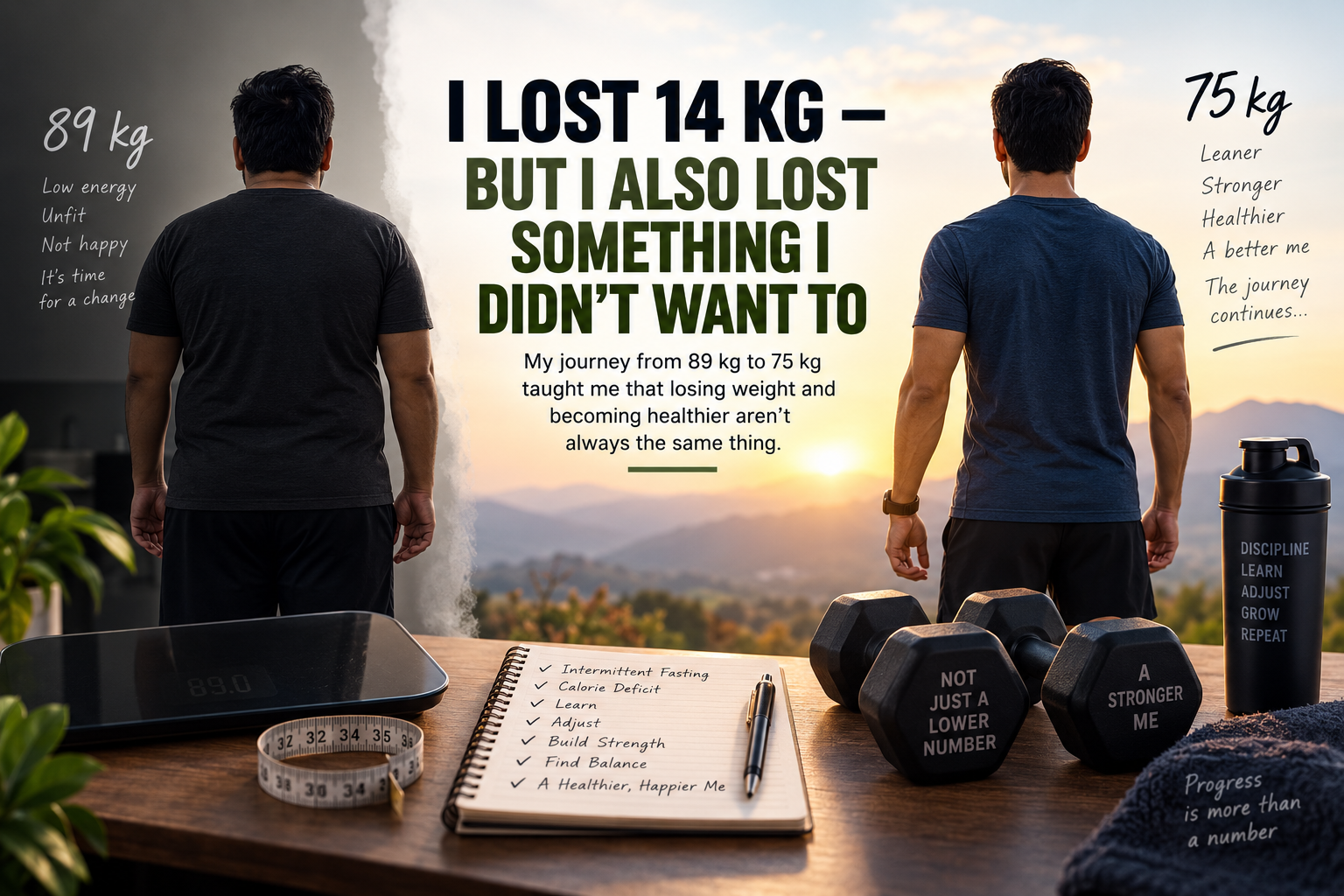
Going from 89 kg to 75 kg felt like success. But somewhere along the way, I realized that losing weight and becoming healthier were not necessarily the same thing.
When I first decided to take my health seriously, my goal seemed obvious:
Lose weight.
I was around 89 kg when I started.
And once I made up my mind, I went at it with discipline.
I started intermittent fasting, usually fasting for 16 to 18 hours a day. At the same time, I significantly reduced how much I was eating and maintained a calorie deficit.
I became very conscious about food.
How much I was eating.
When I was eating.
And, perhaps more than anything else, what the weighing scale was telling me.
And it worked.
89 became 85.
85 became 80.
Eventually, I reached around 75 kg.
Fourteen kilos gone.
It felt like an achievement.
And it was.
But there was another side to it that I had not planned for.
I Had Lost Weight. But Had I Become Fitter?
When your goal is weight loss, watching the number on the scale fall can become strangely satisfying.
Every kilogram feels like progress.
So naturally, reaching 75 kg felt like success.
I looked considerably leaner.
But when I looked at myself more carefully, I realized something.
I had not just become leaner. I had also lost muscle along the way.
That was not part of the plan.
I had not started this journey because I wanted to become skinny.
I wanted to become healthy and fit.
And for the first time, I started understanding that those things are not necessarily measured by how little you weigh.
The weighing scale was telling me one story. My body was telling me another.
The Scale Does Not Tell You What You Lost
This seems obvious to me today.
It was not obvious when I started.
When the scale says you have lost one kilogram, it does not tell you exactly what you lost.
It just says:
-1 kg
When I was focused entirely on bringing that number down, I was not thinking enough about maintaining strength and muscle.
My thinking was mostly:
Eat less -> Lose weight -> Become healthier
But eventually, I realized the equation was not quite that simple.
I had successfully lost a significant amount of weight.
Now I needed to think about the quality of the body I was building, not simply how much it weighed.
That changed my goal completely.
I Stopped Trying to Become Lighter
The question gradually changed from:
"How much more weight can I lose?"
to:
"How can I become stronger?"
That is when my approach to fitness started changing.
Strength training became more important.
Protein became more important.
Recovery became more important.
And my relationship with food began changing too.
Until then, food had largely become something I needed to restrict to make the scale move.
Now I was beginning to see it differently.
Food was also fuel.
If I wanted to train, recover, maintain muscle and become stronger, my body needed proper nutrition.
It sounds incredibly obvious when I write it now.
But sometimes you have to experience something yourself before you truly understand it.
I Do Not Regret the Weight-Loss Phase
It is easy to look back at something and criticize what we did before we knew better.
I do not want to do that.
I do not regret it.
Intermittent fasting helped give structure to the way I ate.
Being conscious about calories taught me how easy it is to consume far more food than we realize.
And losing 14 kg required discipline and consistency.
That phase taught me a lot about my body.
But it also taught me something equally important:
Achieving a result and building a sustainable lifestyle are two different things.
I do not want to spend the rest of my life constantly trying to eat less.
I do not want every meal to become a mathematical calculation.
And I am no longer interested in chasing the lowest possible number on the scale.
My Definition of Progress Has Changed
Today, progress means something very different to me.
I am much less interested in simply weighing less.
I am interested in strength, muscle, energy and how I feel.
Can I lift more than I could a few months ago?
Am I getting stronger?
Do I have enough energy throughout the day?
Am I eating well without constantly feeling deprived?
Can I enjoy a meal without feeling guilty about it?
And perhaps the most important question:
Can I live like this for years instead of weeks?
Those questions matter more to me now.
Weight Loss Was Only the First Part
Looking back, going from 89 kg to 75 kg was not the end of my health journey.
In many ways, it was only the beginning.
The first phase taught me that I could change my habits.
The next phase is teaching me something harder:
How to find balance.
I am learning how to eat enough to support my body without returning to my old habits.
How to prioritize protein without turning every meal into a calculation.
How to train consistently without making the gym my entire life.
How to become stronger without obsessing over the weighing scale.
And how to enjoy food while still being mindful of what I am putting into my body.
I am still figuring some of this out.
And I have realized that is okay.
There is not a finish line where you suddenly understand everything about health.
You learn.
You experiment.
You make mistakes.
You adjust.
And you keep going.
What I Would Do Differently Today
If I were starting again, I would not abandon the things that helped me lose weight.
But I would approach them differently.
I would still be mindful of calories.
I would still pay attention to how often and how much I eat.
But I would also think about things I did not appreciate enough the first time around:
Protein. Strength training. Recovery. Sleep. Muscle. Energy.
And instead of asking only:
"Is my weight going down?"
I would also ask:
"Am I becoming healthier and stronger?"
That small difference in thinking changes the entire journey.
The Lesson the Scale Could Not Teach Me
When I started, I thought success would be seeing a particular number on the weighing scale.
I reached that number.
But the experience taught me something far more valuable.
Losing weight and building health are not always the same goal.
The scale is useful.
But it is only one number.
It cannot tell you how strong you are.
It cannot tell you how much energy you have.
It cannot tell you whether your lifestyle is sustainable.
And it certainly cannot tell you whether you are happy living this way.
Today, my goal is not to become lighter.
It is to become stronger, healthier and more capable while still enjoying my life.
I lost 14 kg learning how to eat less.
Now I am learning something much more important:
How to build myself back stronger without losing the balance I was searching for in the first place.
Continue exploring
Has your definition of health changed after chasing a specific goal?
Join the conversation
Different perspectives make these conversations more useful. Share your experience or point of view.
Conversation guidelines
Respectful disagreement, personal experience and constructive discussion are welcome. Harassment, spam and medical misinformation presented as diagnosis are not.
Loading conversation...